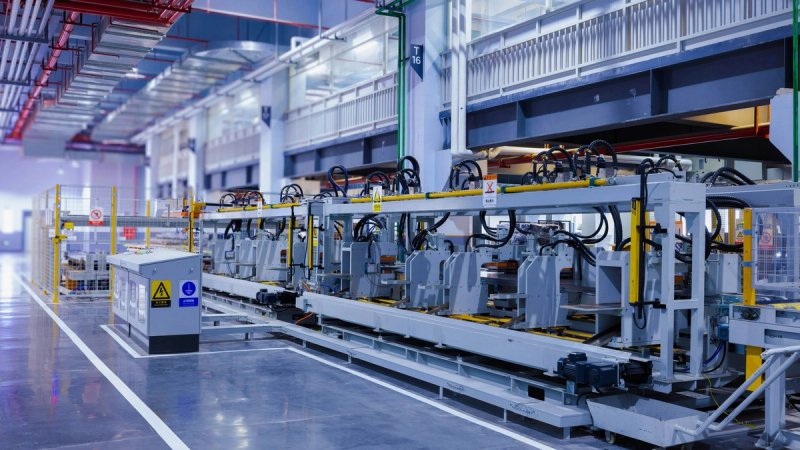
In Hefei, roughly 400 km west of Shanghai, Chinese car manufacturer NIO told us they can build a car to order in two weeks, from confirmed order to finished vehicle. Walking across the factory floor explains how.
Roughly 100 suppliers sit in a tight ring around the production line. Some are connected to it by physical tunnels for synchronized, just-in-time component delivery. The Hefei municipal government even invested around $1 billion in NIO in 2020 (Bloomberg cited Bernstein analysts using a more direct word: bailout) and built the cluster around them.¹ Wait times for some of their latest model EVs, like the ES8, run in the same two-week range. Inventory is close to zero and they have built an integrated industrial machine, with NIO as the front end.
That picture held through eight company visits I made over six days earlier this year: BTR (battery anode materials), HyperStrong (storage), Guofuhee (hydrogen infrastructure), Ambilight (electrochromic glass), JA Solar (PV), Marvel-Tech (hydrogen turbines), Windrose (electric trucks), and finally NIO.
The CEOs volunteered their domestic value share with pride. At Marvel-Tech, roughly 97% of the value chain is domestic; others quoted figures between 95 and 98%, with only a handful of international suppliers left.² There is a broader geopolitical and macroeconomic context behind these numbers that I learned to appreciate more during the trip, and it explains a lot about the China of today.
While Europe built its economy for a peaceful, globalized world, China built its economy for a potentially adversarial one. Absolute self-sufficiency is the stated goal, and a 97% domestic value chain is what that goal looks like on a shop floor.
Manufacturing is also treated as worth keeping for its own sake. The economics most of us learned in school runs the other way: countries climb from agriculture to manufacturing to services, production goes wherever it is cheapest, and trade covers the rest. By that logic, letting factories migrate was progress. China is run by a political class dominated by engineers, and Dan Wang's Breakneck (I strongly recommend you read it) traces what that does to industrial policy.³ You can feel it on the factory floor.
China's 15th Five-Year Plan, published in March, names 109 priority engineering projects that put green hydrogen, new-type batteries, and nuclear fusion in the same strategic category as semiconductors and AI.⁴ Beijing is planning its energy system the way other governments plan a buildout of their armed forces.
We are now operating in the version of the world China prepared for, and in commodity climate hardware, China has already won.
Five comfortable stories that fall apart inside the factories
Most Western thinking about Chinese climate tech runs on a few standard explanations.
1. The cheap labor story
The belief: China wins on wages, so its lead is a race to the bottom that Europe is right to sit out. The real gap is elsewhere. The IEA's Energy Technology Perspectives 2024 puts it bluntly: it costs roughly 45% more on average to manufacture solar PV modules, wind turbines, and batteries in the European Union than in China. The report attributes that gap to higher investment, labor and energy costs, together with smaller production scale and supply chains that are not vertically integrated.⁵ Wages are one of those five factors. The rest is systemic: supplier proximity, automation depth, and the fact that a cell plant, anode plant, cathode plant, and final assembly often sit just kilometers away from each other.
2. The copying story
The belief: China copies what others invent, so the durable edge stays with the inventor. Look at who is suing whom: some of the most active patent litigation in solar today is happening between Chinese companies. JA Solar and Astronergy settled a multi-jurisdiction patent dispute in December 2025.⁶ Litigation on that scale only pays when the technology is genuinely yours. China has moved from fast-follower into IP-protected industry.
3. The slow-iteration story
Hardware iteration is supposed to be slow everywhere; whatever China wins on cost, the thinking goes, it cannot win on speed. Iteration is very fast in Hefei. Mass-market European OEMs typically run 12 to 16 weeks for a customer-configured car; NIO runs roughly two.⁷ The pace comes from the same supplier ring as the cost advantage: when your component makers sit next door, a design change travels through the chain in days rather than in quarters.
4. The tariff story
Tariffs slow specific products and they've long been perceived as a useful lever of protection for our domestic industries. However, tariffs struggle to stop a supply chain that is moving sites, partners, and ownership structures faster than the protectionist instruments can be drafted.
BTR is opening cathode plants in Morocco for the European market. Guofuhee operates a 49% German joint venture. Windrose is preparing assembly capacity in Belgium.² Reuters reported in March 2026 that six Chinese OEMs are preparing European heavy-truck launches at prices up to 30% below the European average of €320,000.⁸ By the time a tariff schedule is agreed, the product it targets might already be on an assembly line within your own borders.
5. The goldrush story
The reassuring version is that this is a subsidized gold rush, and gold rushes end in busts that solve the problem on their own. The bust is real: solar module prices fell roughly 50% in 2023 and another 25% in 2024,⁹ and many of the sectors I visited operate at low or negative margins. Plenty of these companies are winning global market share and losing money on every unit at the same time. What the bust delivers, though, is consolidation: fewer, larger, harder suppliers, and Europe will still buy from whoever survives. That matters for European companies that build their products or projects on Chinese components. Before banks and investors fund them, they ask whether the supplier will still exist to honor a long-term warranty and whether the equipment will cost the same next year. In a shakeout, both answers get worse, because some of today's suppliers disappear and the survivors can raise prices.
The system, in physical form
Hefei is what state-led industrial policy looks like when it works. The cluster was financed by the city government and engineered around a single anchor tenant, NIO, whose business required exactly that supplier density. Five years after the bailout, the factory produces on the order of 300,000 vehicles a year.¹ It is what an engineer-run state builds when it treats factories as a national asset; that instinct, more than any single subsidy, is what Dan Wang in Breakneck gets right.³ The nearest European analogues, around Fiat's Mirafiori plant in Turin, now Stellantis, and VW in Wolfsburg, emerged organically from incumbent industrial bases over decades. Few European jurisdictions could permit, finance, and physically construct Hefei's geometry on a five-year timeline.
Roughly 97% of the world's battery anode active materials are made in Chinese factories like BTR's.¹⁰ The chemistry itself is well-known and reproducible; what's defensible is the qualification timeline at OEM-grade quality, with the supplier base sitting next door. That's what 97% looks like up close. The same depth holds at the bottom of the value chain: China makes roughly 95% of the world's rotary compressors, while Europe assembles 73% of the heat pumps sold in Europe.¹¹ The final unit looks European, but the single most critical component is single-sourced from China. Strategic autonomy targets that don't reach upstream are a bit like theater.
Adam Tooze put it directly in his September 2025 Chartbook essay: "Rather than moaning about subsidies, we should recognise that China is the only large country driving the energy transition at anything close to the necessary speed and scale."¹²
Where Europe actually has ground
If the manufacturing war is functionally over in solar, batteries, mass-market EVs, and likely soon onshore wind, the useful question is which adjacent layers China's system advantages don't carry over into.
Software and AI in energy and industry. Grid optimization, predictive maintenance, energy management and energy trading, industrial process AI. Iteration cycles are short, capex is light, and regulation is fragmented enough that local market understanding actually matters: a trading algorithm tuned to German balancing markets is useless in Guangdong, and the other way round. China's manufacturing edges don't map cleanly onto this layer.
System integration and downstream value capture. Project development, IPP models, financing, insurance, performance warranties, certification. Carbon Brief's analysis of CREA data found the downstream value of clean tech in use runs to several multiples of the export value of the components themselves.¹³ A Chinese cell manufacturer can build a battery. Building, owning, financing, and trading energy from a 200 MW European storage asset is a different business, and most of the people who can do that work sit in London, Paris, or Berlin.
Frontier deep tech that hasn't commoditized yet. Fusion, geothermal, specialty materials. Hard to copy, IP-heavy, scale-insensitive. Europe still leads in many of these; the think tank Centre for European Reform identifies this layer as the one where European competitiveness is genuinely defensible.¹⁴
Proxima Fusion raised €411 million in July 2026 for its stellarator program in Munich, with RWE and Google among the investors. Cylib in Aachen recovers lithium, nickel, cobalt, and graphite from used EV batteries, working on exactly the upstream layer where the 97% sits.¹⁵ Behind them stands research infrastructure that took a century to build: three of the five best engineering universities in the world are European (ETH Zurich, Oxford, Cambridge),¹⁶ and EPO member states still produce 27% of the world's high-value clean-tech inventions, the patents valuable enough to file in several jurisdictions at once.¹⁷ On raw patent volume, though, China now files roughly twice as many international energy patent applications as Europe.¹⁷
And there are the sectors where Europe has actually held the line: heat pumps, offshore wind, electrolysers (for now). The window is open and the industrial base is still in place.
Where capital should go
Apply a China filter to every climate hardware deal. Can the company survive Chinese competition on cost and speed, partner with Chinese supply chains where that's the smarter route, or build in a layer where the Chinese system advantage doesn't translate? Avoid commodity hardware where capex scales linearly with revenue and the only differentiator is unit cost. Look for software, system integration, downstream margin, and frontier technology with strong IP.
JA Solar's CTO described the company's strategic objective in a single phrase: lowest LCOE, the lowest levelized cost of electricity over a project's lifetime, which is a different optimization from building the cheapest module.² HyperStrong told us it is moving toward an IPP model: an independent power producer, owning and operating storage assets rather than only selling the systems.² Inside both companies the factory is openly treated as a cost center. The margin is migrating downstream in China too.
AENU has been concentrating capital here since 2023. Entrix, where we invested at seed, is the clearest European case: 3 GW of storage under contract, with the value sitting in trading and optimization rather than in the hardware.¹⁸ Trawa is doing similar work on the C&I energy procurement side. The trip reinforced our conviction of an existing thesis.
As long as European industrial policy defines clean tech ambitions while underfunding the system to deliver on them, dependence on Chinese components stays structural for at least this decade. The Letta and Draghi reports already diagnosed this from above.¹⁹ For an investor, the gap itself manifests with signals like deployment, integration, financing, operations.
China has won large parts of climate hardware, and it is deploying clean energy faster than anyone else. Clean energy drove more than a third of Chinese GDP growth in 2025.¹³ The world needs that.
If Chinese manufacturers are already past the manufacturing layer in the sectors they dominate, European capital probably should be too. If you're building in any of those layers, I'd be glad to hear from you.
Sources
- TechNode, "NIO clinches RMB 7 billion cash injection from Hefei government," 29 April 2020, technode.com; Bloomberg coverage citing Bernstein analysts (2020). Production volume: NIO Hefei public reporting.
- Company statements from the factory visits: Marvel-Tech (roughly 97% domestic value chain); HyperStrong (transition toward an IPP model); JA Solar CTO (lowest-LCOE objective); BTR, Guofuhee, and Windrose localization plans as described to us.
- Dan Wang, Breakneck: China's Quest to Engineer the Future, 2025.
- Outline of the 15th Five-Year Plan (2026–2030), adopted March 2026. English summary: english.www.gov.cn (13 March 2026); the 109 major engineering projects list: npc.gov.cn.
- IEA, Energy Technology Perspectives 2024: 45% average EU-vs-China clean tech manufacturing cost premium, attributed to higher investment, labor and energy costs together with lower production scale and supply chains that are not vertically integrated. iea.org/reports/energy-technology-perspectives-2024
- PV-Tech, "Astronergy and JA Solar end global patent disputes with cross-licensing deal," 1 December 2025. pv-tech.org
- Industry-standard European OEM lead times for customer-configured vehicles; NIO order-to-delivery reporting.
- Reuters, "European freight truck makers brace for wave of low-cost Chinese rivals," Carey & Mannes, 10 March 2026.
- CSIS, China's Solar Industry Is in Upheaval (2025). csis.org
- IEA, Batteries and Secure Energy Transitions (2024): 97% Chinese share of battery anode active material capacity. iea.org
- IEA, The Future of Heat Pumps in China (2024): rotary compressor share. EHPA: 73% of heat pumps sold in Europe are made in Europe. ehpa.org
- Adam Tooze, "Chartbook 409: Beyond the 'Marshall Plan': China's solar boom as world-changing industrial policy," September 2025. adamtooze.substack.com
- Carbon Brief / CREA, "Clean energy drove more than a third of China's GDP growth in 2025," February 2026. carbonbrief.org
- Cornago et al., "Between a rock and a hard place: Europe's clean tech industry," Centre for European Reform, December 2025. cer.eu
- Proxima Fusion, €411M round, 7 July 2026, co-led by XTX Ventures and East X Ventures, proximafusion.com. Cylib, €55M Series A, May 2024, led by World Fund and Porsche Ventures, sifted.eu.
- QS World University Rankings by Subject 2026, Engineering & Technology: ETH Zurich (#3), Oxford (#4), Cambridge (#5). topuniversities.com
- EPO/EIB, Financing and Commercialisation of Cleantech Innovation, April 2024 (EPO member states: 27% of high-value cleantech inventions, 2017–2021). IEA, The State of Energy Innovation 2026: Chinese international energy patent applications roughly 2x Europe's, 2023 data. iea.org
- Entrix, contracted storage milestone (3 GW / 8.5 GWh), March 2026. blog.entrixenergy.com/entrix-funding-1
- Enrico Letta, Much More Than a Market, EU Council, April 2024; Mario Draghi, The Future of European Competitiveness, European Commission, September 2024.