

Skip to content Download
AENU

In partnership with

Download the PDF

The Execution Game

How Europe's most well-funded climate founders were made, and where the next generation is building

Read the study

Scroll to the summary
  • United Kingdom: 23 (Arrival UK, Belltown Group, Brazilian Nickel, Britishvolt, Carbon Clean, Cornish Lithium, CuspAI, Evero Energy, Field Energy, Forest, Gridserve, Hometree, InstaVolt, Meatless Farm, Miro Forestry, Octopus Energy, Onto, Ovo, Plastic Energy, Statera Energy, Storegga, Tokamak Energy, Zenobe Energy)
  • Germany: 20 (Cloover, Enpal, Focused Energy, Formo Foods, green flexibility, Hy2gen, ILOS Projects, INERATEC, Infarm, Lilium, NeXtWind, PAUL Tech, Proxima Fusion, Reload, Sunfire, Tado, TIER Mobility, Traceless, Volocopter, WestfalenWIND)
  • France: 14 (Afyren, Arverne Group, AURA AERO, BW Ideol, Electra, Elicit Plant, Fairmat, Forsee Power, Hoffmann Green Cement Technologies, InnovaFeed, Lhyfe, Qovoltis, Verkor, Waga Energy)
  • Netherlands: 9 (Dott, Fastned, Lion Storage, Mosa Meat, Protix, SkyNRG, Sustainable Fuel Plant, TES, Yeager Energy)
  • Sweden: 8 (Aira, Einride, Elvy, Exeger, Flower Infrastructure Technologies, Northvolt, Stegra, Voi)
  • Switzerland: 6 (Alevo, Atlas Agro, Climeworks, EcoRobotix, Planted., Terralayr)
  • Spain: 4 (Heura Foods, Reolum, Wallbox, Zunder)
  • Finland: 4 (Hycamite, Ilmatar Energy, Ren-Gas, Spinnova)
  • Ireland: 3 (Aer Soleir, Amarenco, Power Capital Renewable Energy)
  • Denmark: 2 (Agreena, Stiesdal)
  • Italy: 2 (Andion CH4 Renewables, Sunprime Holdings)
  • Belgium: 1 (Aphea.Bio)
  • Croatia: 1 (Rimac Automobili)
  • Poland: 1 (R.Power)
  • Estonia: 1 (Sunly)
  • Austria: 1 (Enery Development)

We took the 100 most well-funded climate companies in Europe, across 20 sub-sectors and 16 countries, and traced the careers of the founders who started them: where they studied, where they worked, what they'd built before, and what made them choose these industries to disrupt.

The founder stories that get routinely told are still mostly Silicon Valley software stories. The people building green hydrogen plants, battery factories, alternative proteins, or fertilizer plants rarely find themselves in the limelight. We think they've earned it, and wanted to better understand how they've scaled to such heights.

The next decade of European climate tech belongs to the founders who can take proven technologies to industrial scale, from lab to pilot to full size factory. We call it the execution game. This study maps 100 of them who have already shown they can do just that, or have come a good part of the way.

We kept a selection of failed ventures in on purpose. A study about scaling climate tech that skipped Northvolt (about €12.8B raised) or Lilium (about €1B) would ignore the challenging realities of the market. To compare, we built a matching group of 100 American climate founders using the same rules.

So who are the people raising billions in climate tech?
Nearly half of these founders came out of a large industrial incumbent or energy company. Henrik Henriksson left the truck maker Scania to found Stegra, the green-steel company, and Martin Lewerth left Scania for Aira, which sells heat pumps. Benoit Lemaignan (Verkor, battery cells) and Jérémy Caussade (AURA AERO, electric aircraft) both came through Airbus. The list goes on.

Europe's strength in diversity is also clear when you look at education. Founders studied at nearly 120 different institutions, with no single campus producing more than a handful. The combined weight of Harvard, Stanford and MIT has no direct European equivalent. In this cohort, Cambridge, TU Delft and INSEAD are some of the most represented. For an investor, that makes pedigree a poor filter here. If you only screened founders from three campuses you would have missed most of this list.

Beyond education, the typical founder here had well over a decade of work experience on the day they started, much of it inside the industries they set out to rebuild. The pattern is just as strong across the Atlantic, and the Americans had even more experience behind them: 16 years at the median. One in two had already founded a company before this one.

We sat down with ten of these founders for longer conversations: their journeys, their read on European climate tech and sovereignty, and what they'd tell the founders coming after them.

We close by looking forward and nominating Tomorrow's Champions: 20 founders building in the areas we believe will define the next 15 years of European climate tech. The eight areas are grid infrastructure and flexibility, space, compute and chips, data centers, material discovery, critical minerals and supply chains, adaptation and water, and buildings.

Explore the founders ↓ Jump to Tomorrow's Champions ↓

David Erhun Michelle Piontek
A note from the authors

This study took us deep into Europe's climate tech ecosystem, and we enjoyed every conversation along the way.

David Erhun and Michelle Piontek, AENU

On the market

Currence, formerly Sightline Climate, publishes the CTVC newsletter and runs the market data platform behind it.

Over the past five years, European climate capital has had to absorb a US pullback, an affordability crunch, and multiple energy security crises. It’s been a tough road, but there’s signs of life.

Currence’s data shows that climate capital formation in Europe is holding strong. European funds raised $61 billion in 2025, nearly double the US total of $37 billion, and a complete reversal from 2022 when the US led. EU-originated funds have grown every year since 2020. No other region can say the same. The US remains the largest market with $165bn raised cumulatively, but its trajectory is less certain.

A lot of that stability comes from public capital. The European Investment Fund acts as a cornerstone LP across fund types, from early-stage VC to mature infrastructure, giving emerging managers the credibility to pull in private capital behind them. That's in part why Europe's fund close rate held at 71% in 2025, while the US's collapsed to 35%. State-backed investors like Bpifrance and High-Tech Gründerfonds also remain among the most active early-stage backers on the continent. It's a model the US doesn't have, especially anymore.

But the shape of the capital matters as much as the size. In H1 2026, Europe's VC investment rose 78% year-on-year to $7 billion, its strongest first half since 2022. Much of that money went to deep tech and clean firm power. The hard-to-abate sectors are still waiting for capital to follow the founders in. After Northvolt, investors are cautious about European hardware scale-ups even where policy support exists — and while the Carbon Border Adjustment Mechanism (CBAM) and the Clean Industrial Deal are signals, they’re not guarantees. The more durable driver is that European industry is under real cost and security pressure, a consequence of the continent’s sustained energy shocks, from Russia to Iran.

Raised by climate funds, 2025 Europe $61 billion US $37 billion

That's the opportunity for the next generation of founders. Grid infrastructure and long-duration storage, where Europe already leads globally in deployment, are driven by a renewables buildout that needs balancing, and a data center boom that's adding demand. Plus, industrial decarbonization in steel, cement, and process heat, has European incumbents as some of the biggest customers. There's pressure, but that's when industries get built and founders get made.

3,784 European companies founded since 2009 had raised €50M or more by May 2026, according to PitchBook. 603 of them pass our climate definition and 418 of those are founder-led.

Our climate definition: A company whose core product or service is primarily designed to reduce, remove, or avoid greenhouse-gas emissions, decarbonize energy or industrial systems, or build climate resilience, with a measurable climate impact that would not exist absent the company.

We sorted the 418 into 20 sub-sectors, gave each a quota and picked the best-funded companies inside each, 100 in all. Ranked by capital alone, the 100 would open with 30 solar companies and leave out sectors like geothermal entirely.

10 of the 100 have since shut down or been through insolvency. We kept a selection of failed ventures in on purpose as a study about scaling climate tech that skipped these would ignore the challenging realities of the market. More details on how we got from 3,784 to 100 are in the methods section.

For comparative purposes, we mirrored this with 100 US founders, selected in the same way from 10,000 companies.

The 100 European climate founders

Companies Founders

The 100 American climate founders (the comparison group)

Companies Founders
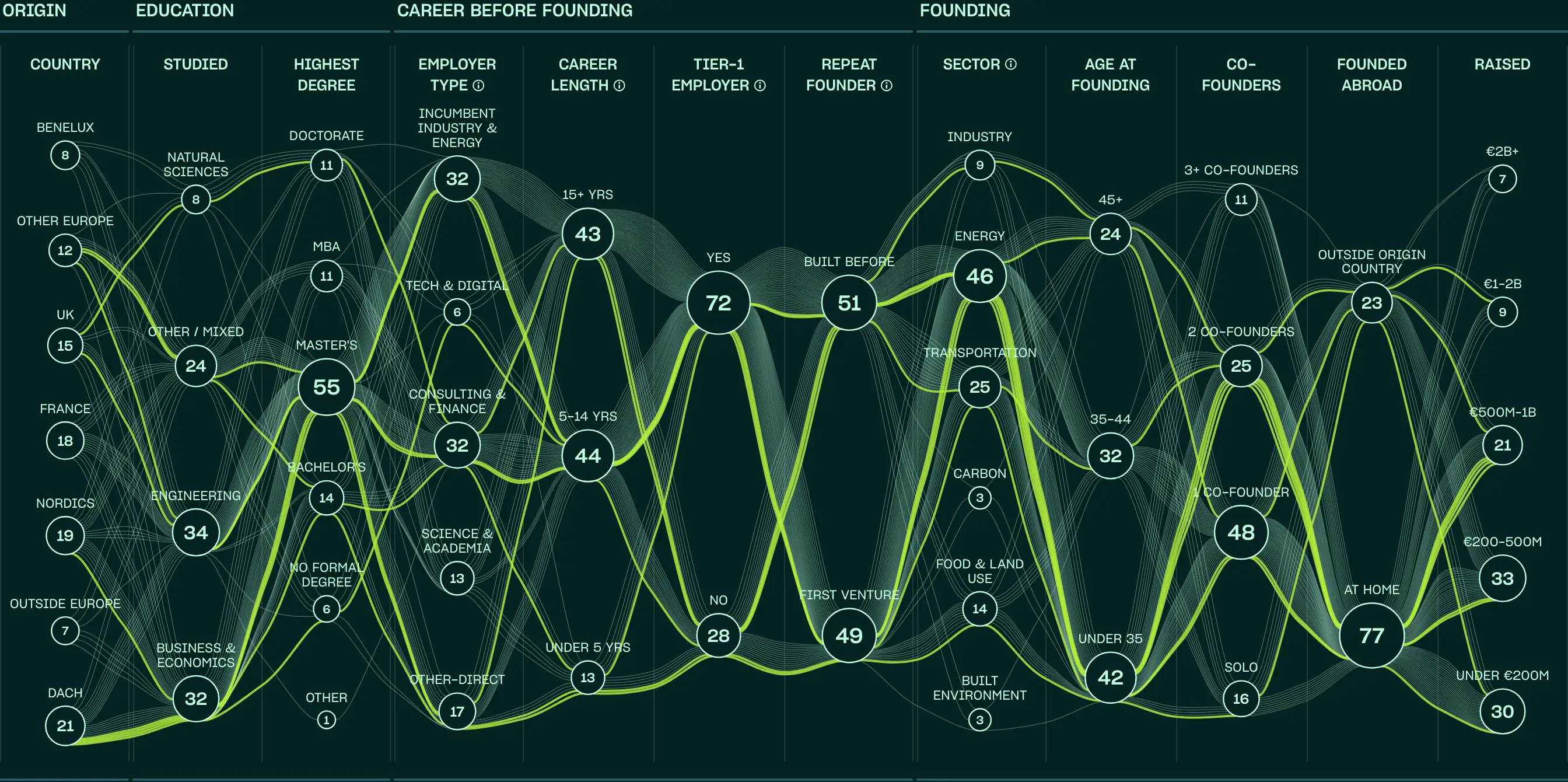
Each line is one founder, read left to right from where they grew up to capital raised. Click a circle to see everyone who passes through it. Toggle US Cohort to compare, or pick a founder below to follow their line.Each line is one founder, read left to right from where they grew up to capital raised. Tap the chart to enlarge it, or pick a founder below to read their story.

Explore

The threads chart: twelve columns from origin country to capital raised, one line per founder. The interactive explorer works best on a larger screen.

In their own words

A word for future founders

Authors' note: Hometree is an AENU portfolio company.

Simon Phelan, one of the 100 founders in this study, made his first hires at Hometree: the two men, both in their early sixties, who had built British Gas's home-cover business. Jonathan Rose places people like them for a living. This is his view of when it works.

On paper, the first senior hire for an early-stage company is clear. You've raised your first round, you're building in an industry that you yourself also are growing in, and there is a potential hire who has spent twenty or thirty years inside it at a large corporate. They know everyone. They can get you through the door with your biggest customers. Your company gains visibility, credibility, and reach immediately.

Their big picture thinking is transferable. As you scale up, their organisational experience is as well.

Where it can break down is a little less obvious, and it's usually one (or all) of three things:

  • Startups make decisions fast, for good or for bad. In a large corporate change happens slowly. How is someone going to be used to that?
  • A senior executive may never have been an individual contributor, or not for a very long time. How will they cope rolling their sleeves up and doing something different every day?
  • Coming from a large corporate, they have operated something rather than built it. They managed a product that was already there. They may well have improved it. But have they brought something into the world?

There is no right or wrong answer here. Some experiences of hiring from large corporate companies can be revolutionary for early-stage scaleups; some can set them back 2 years.

Mostly it comes down to your hiring process. Being clear on who you need and why, being honest about the challenges/risks you'll both face together and truly spending time diving into the pros/cons of each candidate before you make your move.

Tomorrow's Champions — who shapes the future?

The 100 companies above show who got funded at scale. This section looks at which founders may join the cohort next.

We're excited about the emerging corners of climate tech, and we've picked eight of them on purpose to avoid conflicts of interest, sectors where AENU hasn't invested yet, or at the edge of our current portfolio. We invest in companies working across the energy transition, industrial transformation and systemic resilience. Grid infrastructure and flexibility, space, compute and chips, data centers, material discovery, critical minerals and supply chains, adaptation and water, and buildings. In each one, our investment team named the founders they believe could be building the next scaleups in their field.

None of these founders is one of the 100, and none of them is in our portfolio, as of September 2026. We'd like to share our excitement and encourage more people to put these founders on their radar.

Their names are on the next screen.

Principal authors

Comments, questions or contributions?

We would like to hear from you.

Write to us

AENU is a European early stage VC investing in energy transition, industrial transformation and systemic resilience technologies. The AENU team includes former unicorn founders, climate activists, and investors from Earlybird, Macquarie, and Speedinvest. The portfolio of the €170M first fund includes category leaders like Monta, Entrix, Ember and Trawa accelerating Europe's industrial transition.

Publishing partner

Green Executives is a transatlantic search firm exclusively dedicated to the green economy. Founded by an energy executive, they bring a deep understanding of renewable infrastructure, cleantech, and the investment landscape. They partner with investors, portfolio companies, and industry leaders to identify and appoint transformative talent, aligning leadership with sustainability goals.

Where the 100 came from

We started with every European company founded in 2009 or later that had raised €50M or more. 3,784 companies, according to PitchBook. We ran each against our own climate definition. 603 passed and we then took out the corporate joint ventures, yieldcos, and obvious asset platforms, none of them founder-led. 418 remained.

  • Annex A: The 100 founders in the study. PDF
  • Annex B: The 100 by capital alone. PDF

What we call climate tech

For the purposes of this study, we defined a climate tech company as one whose core product or service is primarily designed to reduce, remove, or avoid greenhouse gas emissions, decarbonize energy or industrial systems, or build climate resilience, with a measurable climate impact that would not exist absent the company. This excludes carbon accounting platforms, climate fintech, ESG ratings and sustainability consulting.

How we picked the 100

Ranked by capital alone, the 100 would open with 30 solar companies and leave out sectors like geothermal entirely. So we sorted the 418 into 20 sub-sectors, gave each a quota and picked the best-funded companies inside each. The result is 100 companies across 20 sub-sectors and 16 countries. Batteries, solar and low-carbon materials still carry 58% of the roughly €80B they have raised between them. We kept a selection of failed companies on purpose and 10 of the 100 have shut down or been through insolvency. More than half of the 100 raised additional capital in 2025 or 2026.

Which founder we studied

Each company contributes one founder, the person who founded it and ran it, normally the chief executive but not always.

A founder is someone a credible source explicitly calls a founder or co-founder of that company. An executive who joined just after the start and is credited as a founder counts, measured from the company's founding year. An early employee does not count, however important they were.

One person in this report is not a founder. Mark Travers, chief executive of Brazilian Nickel, was hired in 2023 and appears in the interview section. The company's founder, Mike Oxley, is the one we covered in the analysis.

The American comparison

We built a group of 100 American founders by the same rules, for comparison. We screened 10,000 companies, 569 met the definition and we selected a comparable 100 across the same 20 sub-sectors, the ones listed in Annex A.

Sources

Company and funding data are from PitchBook as of May 2026 and Currence as of August 2026. Founder data comes from public sources including LinkedIn, company websites, news media, and public registries. Our 20 sub-sectors sit inside the Currence taxonomy, whose seven sectors the explorer uses: Energy, Transportation, Food & Land Use, Industry, Built Environment, Carbon, and Climate Management. Every figure in this report follows the counting rules under "What each data point means" on this page.

What each data point means

  • Founding year. The year PitchBook records the company as founded.
  • Career start. The year of the founder's first paid job we could identify. Time in education does not count, at any level. Paid work counts even when it is training: postdocs, hospital residencies, military service, apprenticeships. Internships do not count, but starting a prior company counts as a job.
  • Career length. Founding year minus career start. Founding straight out of university means 0 years.
  • Age at founding. Founding year minus birth year, shown as bands in the charts.
  • Repeat founder. Founded another company before this one. Yes only if a credible source names them founder or co-founder of it. Early employees do not count.
  • Sector. The company's sector in the Currence taxonomy: Energy, Transportation, Food & Land Use, Industry, Built Environment, Carbon, or Climate Management. Our 20 sub-sectors sit inside it.
  • Co-founders. How many co-founders supported the founder we studied, not counting that founder. Only people a source explicitly calls a co-founder count.
  • Employer type. The space a founder worked in before this company: industry and energy, consulting and finance, science and academia, tech and digital, or none of them. A year or more of paid work in a space counts, and a PhD counts as science. We report this two ways. "Main background" gives each founder one space, the one they spent longest in, so the figures add up to 100. "Passed through" counts every space they spent time in, so those figures add up to more than 100, because many founders worked in more than one.
  • Tier-1 employer. The founder worked, before founding, at a large established or globally recognized company: McKinsey, Siemens, Shell, Google and their peers. Small and mid-sized companies, universities, internships and the founder's own companies do not count.
  • Raised. Everything the company has ever raised, including debt and project finance, in euros, according to PitchBook.
  • Country. Where the founder was born or grew up, grouped into regions. This is the founder, not the company.
  • Studied. The field of the founder's main degree: engineering, natural sciences, business and economics, or other.
  • Highest degree. The last qualification completed. For example, a French engineering diploma counts as a master's. Medical and law doctorates are not PhDs.
  • Founded abroad. The founder started the company outside their country of origin.

AENU is an investor in two companies in this study: Agreena and Hometree.

AENU

In partnership with

Pass it on.

Know someone who should read this?

Back to the Explorer ↑