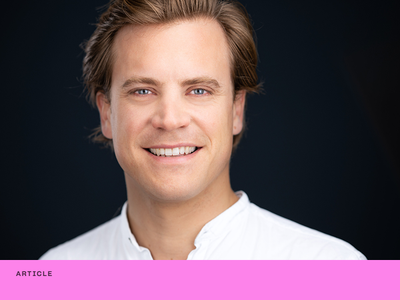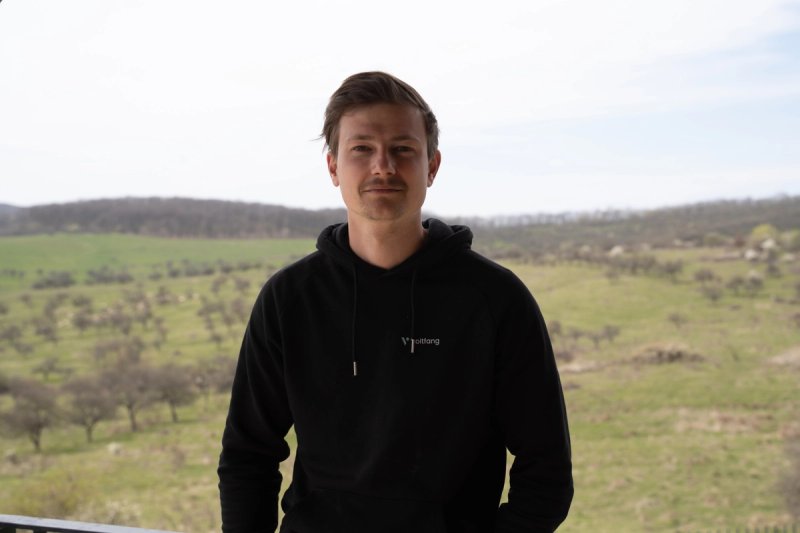
My name is Roman Alberti, CEO and co-founder of Voltfang, where we give pre-used EV batteries a second life as stationary energy storage. Together with my two co-founders, I turned a student project and a passion for technology and sustainability into a company that tackles one of the biggest blind spots of the energy transition: the end of life of electric car batteries.
From an early age, I was fascinated by technology and cars. Working on vehicles gave me a practical understanding of engineering, which I later deepened at RWTH Aachen. Internships at Maybach and e.GO showed me that large corporations are often too slow and constrained for the kind of impact I wanted to have. At the same time, my growing environmental awareness made it clear that I wanted to align my work with climate protection.
Founding Voltfang was the logical next step: using my passion for technology to actively support the German energy transition while solving the ecological and economic challenge of used EV batteries.
Elevator pitch for Voltfang
Voltfang integrates used electric vehicle batteries into stationary storage systems, extending their lifespan and significantly reducing their ecological footprint. Our product, Voltfang Industrial, enables SMEs to store renewable energy, perform peak shaving and load shifting, and contribute to grid stability.
Vision for 2030
By 2030, Voltfang will be one of the leading companies driving the energy transition. Our goal is to connect our storage systems into a virtual power plant capable of replacing the coal-fired power station in Weisweiler, Germany.
Key challenges in the renewable energy sector
Public debate often focuses on installed peak capacity and record days for wind and solar. The bigger challenge, however, is managing the fluctuation of renewable generation. Today, conventional power plants still balance the gap between production and consumption and stabilize the grid. As these plants are phased out, we risk losing this stabilizing function.
To avoid that, storage systems must increasingly take over the role of power plants. We need to make prosumers and consumers as self-sufficient as possible, sector by sector, and rely on virtual power plants to balance the rest.
Role of renewable energy and Germany’s responsibility
There is currently no viable alternative to renewable energy for a sustainable future. We must continue to expand renewables and support them intelligently if we want to reach our climate targets.
Germany plays a key role: we are among the leading nations in renewable expansion. Our task is to implement a rapid and truly ecological energy transition so that other countries see us as a role model and are inspired to build their own CO₂-free energy systems. Since Germany accounts for only about 2% of global CO₂ emissions, our greatest leverage is to be imitated and to develop and export the necessary technologies.
View on the circular economy
A circular economy is the only path to a truly sustainable economy, and it must be thought of globally, not just within national borders. It’s not enough to call electric cars sustainable just because they run on green electricity. We need strategies that consider the entire vehicle lifecycle—from the door handle to the battery.
The planet does not have enough resources to sustain our current consumption patterns, and these resources do not regenerate on human timescales. Today, we consume roughly twice as many resources as Earth can regenerate, and by 2050 we would need about five times as many to cover basic needs worldwide.
I share Andrew Morlet’s view (CEO of the Ellen MacArthur Foundation) that the circular economy is often misunderstood as just "Reduce–Reuse–Recycle". In reality, it is a much bigger idea: a fundamental restructuring of how we design, produce, and use everything—challenging the logic that has guided us since the first steam engine.
Why I’m optimistic about the future
Our parents’ generation created a world of prosperity and advanced technology, but often at the expense of the climate. Our generation’s task is to correct this course. We now have both the wealth and the technological tools to fight climate change—we just need to use them.
In my daily life, I see many people changing the way they think about our planet. Our employees, other start-ups, and many individuals are driven by a genuine mission to contribute to a better world. It will be our generation’s responsibility and calling to prevent the climate crisis by reinventing the economy and our behavior. I am optimistic that we can succeed if we work together.
Advice for aspiring entrepreneurs
First, trust yourself enough to start. You’ll be surprised how much support is available once you take the first step. Second, actively seek advice and learn from experts until you become one yourself. Finally, build your company around something you truly stand for. That conviction will give you the endurance to overcome setbacks and lead your business to success—whatever success means to you personally.
My name is Roman Alberti, CEO and co-founder of Voltfang, where we turn pre-used EV batteries into high-performance stationary storage systems. During my studies at RWTH Aachen, my co-founders and I converted an old camper van to be energy independent and stumbled upon the massive, unresolved problem of what happens to electric car batteries at the end of their first life. That insight became the starting point for Voltfang.
From a young age, I was fascinated by technology and cars, building a hands-on understanding that I later deepened through my engineering studies. Internships at Maybach and e.GO showed me that large corporations are often too slow and rigid for the kind of impact I wanted to have, especially when it comes to environmental responsibility. Over time, my growing climate awareness and my passion for technology converged into a clear goal: use engineering and entrepreneurship to actively protect the climate.
With Voltfang, we give EV batteries a second life. We integrate used electric vehicle batteries into stationary storage systems, significantly extending their lifespan and reducing their ecological footprint. Our flagship product, the Voltfang Industrial, enables SMEs to store renewable energy, shave peaks, shift loads, and help stabilize the grid.
By 2030, I see Voltfang as one of the leading companies driving the energy transition. Our vision is to network our storage systems into a virtual power plant capable of replacing conventional fossil power plants such as the coal-fired power station in Weisweiler, Germany.
One of the biggest challenges in the renewable energy sector is not just installing more solar and wind capacity, but dealing with their fluctuation. Today, conventional power plants still balance the gap between production and consumption and stabilize the grid. As we phase them out, we must replace that stabilizing function. Storage systems need to take over the role of power plants, making prosumers and consumers as self-sufficient as possible and relying on virtual power plants for the rest.
Renewable energy is non-negotiable for a sustainable future. Germany, as one of the leading nations in renewable expansion, has a special responsibility: we must achieve a rapid and truly ecological energy transition so that other countries see a working model they can emulate. Since Germany accounts for only about 2% of global CO2 emissions, our greatest leverage lies in being a role model and technology provider for a CO2-free energy system worldwide.
I see the circular economy as the only viable path to a sustainable economy. It must be thought of holistically and globally, not limited by national borders. It’s not enough to call electric cars sustainable just because they run on green electricity. We need strategies that consider the entire vehicle lifecycle—from the door handle to the battery. Our planet does not have enough resources to satisfy our current consumption patterns, and these resources do not regenerate on human timescales. We are already consuming about twice what Earth can sustainably provide, and by 2050 we could need five times as many resources just to cover basic needs. I share Andrew Morlet’s view that the circular economy is much more than “Reduce–Reuse–Recycle”; it’s a fundamental redesign of how our economy works.
Despite the challenges, I’m optimistic. Our parents built a world of prosperity and advanced technology, but often neglected the climate. Our generation now has both the wealth and the tools to correct this course—if we act. I see a real shift in mindset: employees, founders, and many others are driven by an intrinsic motivation to contribute to a better world. Our task is to reinvent the economy and our behavior to prevent the climate crisis, and I believe we can succeed by working together.
For aspiring entrepreneurs, my advice is threefold: First, trust yourself enough to start—once you do, you’ll be surprised how much support is available. Second, actively seek advice and learn from experts until you become one yourself. Third, and most importantly, build something you truly stand for. Only then will you have the resilience to overcome setbacks and lead your company to success—whatever success means to you.