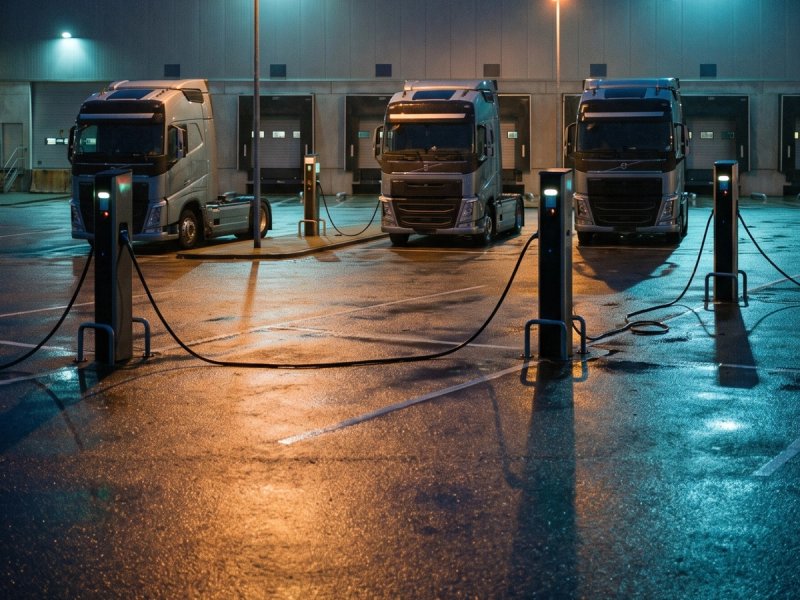
By Robert Stoecker, Leo Allgoewer and Felix Nies
Trucks are about 2% of vehicles on Europe's roads, yet heavy-duty vehicles produce more than 6% of the EU's greenhouse-gas emissions, roughly 27% of everything road transport emits.¹ Almost all these trucks run on diesel, which still powered 92% of new EU truck registrations in the first half of 2026.²
We spoke with more than 50 startups and dozens of large logistics operators, depot developers, investors and consultants. Our conclusion: the hard part has moved from the truck to the depot. We expect most of the venture value to sit with companies that take the complexity of running a depot off the fleet owners' hands, above all the software that decides when, where and at what price each truck charges, both in day-to-day operations and in the high-capex build-out.
The trucks are arriving
The truck itself is ready. More than 60 zero-emission models are on sale in the EU,³ EU production doubled to more than 13,000 units in 2025,⁴ and for trucks that return to a depot every night, electric already matches or beats diesel per kilometre in Germany.⁵ By 2030, Strategy& expects electric trucks to be about 25% cheaper per kilometre than diesel across Europe.⁵
Adoption is still early. Electric trucks went from 2.3% of new EU registrations over 3.5 tonnes in 2024 to 4.8% in the first half of 2026,⁶ ² and the roughly 30,000 on EU roads at the end of 2025 were well under 1% of the 6.2 million in use.⁷ Strategy& puts their share at about a fifth of new European sales in 2030 and more than half by 2035, broadly in line with MAN's forecast.⁵ ⁹ The March 2026 change to the CO₂ rules lowers the zero-emission share truckmakers need by 2030, so demand will arrive later and less evenly.¹⁰ The startups we back have to work without regulatory tailwind and must save operators real money per kilometre.
The fleet can only grow as fast as depot charging gets built. By 2030, this transition will drive roughly 20 TWh of annual electricity demand across Europe, with about 75% of it behind depot gates.⁸ That turns depots into major industrial power buyers and opens a large new market for PPAs, on-site solar and battery storage, and energy management systems.
Why the depot is the bottleneck
Most trucks charge where they sleep. McKinsey expects more than 90% of the roughly 300,000 truck charge points Europe needs by 2030 to sit at private depots and hubs, taking about €5.5bn of the €7bn charging spend.⁸ Building an electric depot is hard for four reasons.
It is grid-bound. A new connection takes a few years in Germany, France and Spain and up to a decade in the UK, and the first company to connect in an area often pays for the local upgrade.¹¹ Operators told us the grid now decides which depots they electrify first. Fees are billed on the highest peak, so if every truck plugs in at shift end, the operator pays for that spike all year.
It is complex. A depot owner suddenly handles real estate, energy, financing and dispatch at once, and the tools for each were never built to work together. With a few trucks, charging can be planned by hand. With a full fleet, it can't.
It is capital-intensive. Operators told us that a depot for just 5 to 10 trucks can easily cost millions: chargers, a transformer, the grid connection and often a battery. Almost all of it has to be paid up front. And since around 99% of European road-freight firms have fewer than 50 employees, that cost falls hardest on the operators least able to finance it.¹²
The market is young. Fleets renew trucks one at a time, so a new depot sits mostly idle at first. Public charging can't fill the gap: it is still scarce and charging on the road is expensive. Nor is there an established second-hand market yet: many of the countries that usually buy used trucks lack the charging to run them,¹³ so residual values are guesswork.
When software stops being optional
Two of these problems get worse with every truck a depot adds: the peak load and the complexity. One operator runs its first e-trucks on fixed double shifts and says that works now but won't at scale. A depot developer put it in stages: for pilots and the first three or four trucks, customers pay to solve the peak charge; the grid becomes the wall at the second and third expansion.
By then, the existing tools don't fit. Route details and schedules sit in the transport management system (TMS), chargers in charge-point software, and site power, storage and solar in energy management. There are more than 1,500 TMS vendors worldwide.¹⁴ The biggest gap is optimising across all assets by departure time.
When we asked what one depot energy system should do, operators gave much the same answer: bring chargers, battery, solar, building systems and later the TMS together, forecast each truck's energy demand and keep cost and peaks down. One said they would pay for real optimisation, bought in modules, without heavy lock-in. The developer added that customers want the result: every truck charged when it must leave, and a clean link into their TMS.
Where we think the venture value sits
We sort the market into five layers:
- Vehicles and powertrain
- Charging and site hardware
- Charging operations and development
- Software and data
- Energy market access and flexibility
We stay out of the first two. That money already has an owner: Daimler Truck, Volvo, TRATON and Iveco sell about two thirds of the EU's e-trucks,⁴ chargers keep getting cheaper, and Chinese makers are arriving with lower prices. Public corridor charging, led by Milence (the Daimler Truck, Volvo and TRATON joint venture), runs on infrastructure money, not venture capital.
Our conviction sits higher in the stack: the software and energy setup that decide when, where and at what price each truck charges. Those layers are small today, but they grow with every truck, charger and battery a depot adds. We look in four areas across layers three to five.
Depot orchestration: the answer to the grid wall and the complexity. A depot that can't get more grid has to make better use of the connection it has, and one run on four disconnected tools needs a single system on top. Energy management plus a depot operating system does both. The software decides which truck charges when, flattening the peak the grid bill is based on and fitting more trucks on the existing connection. k2.mobility's PANION runs charging for fleets such as ASKO in Norway, with more than 300 electric trucks,¹⁵ and Berlin-based Elu Mobility does the same for Rüdinger Spedition, whose 30-plus electric trucks share 2.6 MW of chargers on a 1 MW grid connection.¹⁶ Underneath, charger control often runs on software such as Monta, one of our portfolio companies, while emerging players like Pleevi and Zympler handle the energy-management layer. We think the companies that integrate vertically, from charger control to energy management and beyond, earn more per depot with every truck a fleet electrifies. This is where our conviction is highest.
Flexibility and storage: the other half of the grid fix. Software spreads the load, but a weak connection still needs a buffer. The operators we spoke to already use or plan a stationary battery: it caps the peak, makes a weak connection workable and earns money on the grid while the trucks are out driving. Our portfolio companies Voltfang and Tesvolt build this storage for commercial sites, and Entrix trades stored power from battery assets in day-ahead, intraday and balancing markets. The bigger prize is the truck battery itself, 400 to 600 kWh that sits plugged in for hours between shifts: Scania fed 750 kW back to the grid over the megawatt charging standard in May 2026.¹⁷ It is still early, gated on a bidirectional charging standard and OEM battery warranties, and we are watching who turns it into a business for parked truck fleets.
Charging-as-a-service: the answer to the capital cost. If a small haulier can't fund a depot worth millions, someone else steps in. Developers build the grid connection, storage, chargers and software, then sell the charging on a long-term fixed-price contract. Decade Energy, out of France, raises project capital for the sites separately from venture equity for its platform,¹⁸ and Delta Charge pairs depot batteries, chargers and energy management with a fixed price.¹⁹ Every major truckmaker runs its own offer, such as Scania's Erinion, Volvo Energy and Daimler TruckCharge, though only some focus on the depot, so independents face the OEMs from the first contract. We want independents with neutrality across truck brands and a real edge in energy.
Depot marketplaces: the answer to idle depots and scarce, expensive on-route charging. Many depots have idle chargers when another fleet needs one. Depotcharge, for example, opens a depot's chargers to outside trucks and runs the billing and monthly payouts back to the host.²⁰ Cheap to scale, but it only works once the market matures and enough depots and fleets join one region.
What we look for
- Founder network: Founders with the logistics and energy relationships to open the first depots.
- Traction: Named fleets or depot operators already paying, ideally with an anchor logistics partner, and a proven path from one depot to a fleet's whole network.
- Believable playbook: A credible path to vertically integrate into new product offerings as the fleet electrifies.
If you run a depot, build software for one or finance the hardware, we'd like to hear where you think we're wrong.
How we worked: we mapped startups across the five layers and modelled fleet adoption and depot demand in Europe to 2035 against the published forecasts cited here.
Download the full visual explainer here.
Sources
- EEA, Sustainability of Europe's mobility systems 2025 (climate). https://www.eea.europa.eu/en/analysis/publications/sustainability-of-europes-mobility-systems-2025/climate; European Commission, Lorries, buses and coaches. https://climate.ec.europa.eu/eu-action/transport-decarbonisation/road-transport/lorries-buses-and-coaches_en; ACEA, Vehicles on European roads 2025. https://www.acea.auto/files/ACEA_Report_-_Vehicles_on_European_roads_2025.pdf
- ACEA, New commercial vehicle registrations H1 2026, 29 Jul 2026. https://www.acea.auto/cv-registrations/new-commercial-vehicle-registrations-vans-1-9-trucks-9-8-buses-22-7-in-h1-2026/
- ACEA, Driving Europe's green transition with zero-emission trucks and buses. https://www.acea.auto/news/driving-europes-green-transition-with-zero-emission-trucks-and-buses/
- IEA, Global EV Outlook 2026 (Manufacturing and trade). https://www.iea.org/reports/global-ev-outlook-2026/manufacturing-and-trade
- Strategy& (PwC), Volt rush: the global race for truck electrification (Truck Study 2026), Sep 2026. https://www.strategyand.pwc.com/de/en/industries/transport/truck-study.html
- ACEA, New commercial vehicle registrations 2025. https://www.acea.auto/cv-registrations/new-commercial-vehicle-registrations-vans-8-8-trucks-6-2-buses-7-5-in-2025/
- European Alternative Fuels Observatory, EU27 vehicles and fleet (N2 and N3). https://alternative-fuels-observatory.ec.europa.eu/transport-mode/road/european-union-eu27/vehicles-and-fleet; ACEA, Vehicles on European roads 2026. https://www.acea.auto/files/ACEA_Report-%E2%80%93-Vehicles_on_European_roads_2026.pdf
- McKinsey, Building Europe's electric truck charging infrastructure, Sep 2024. https://www.mckinsey.com/industries/automotive-and-assembly/our-insights/building-europes-electric-truck-charging-infrastructure
- MAN Truck & Bus with McKinsey Center for Future Mobility, Beyond Diesel (MAN Strategy Report), Sep 2026, p6, p8, p9 and p33. https://www.man.eu/content/dam/man/corporate/doc/stories/drei-flotten-drei-wege-zur-elektrifizierung/MAN_Beyond_Diesel_BEV%20Strategy%20Report_EN.pdf/_jcr_content/renditions/original./MAN_Beyond_Diesel_BEV%20Strategy%20Report_EN.pdf; via Automotive World. https://www.automotiveworld.com/news/man-report-projects-15-35-bev-truck-share-in-eu-by-2030/
- ICCT, An amendment to the CO₂ standards for new heavy-duty vehicles in the EU, Jun 2026. https://theicct.org/publication/an-amendment-to-the-co2-standards-for-new-heavy-duty-vehicles-in-the-eu-jun26/; electrive, 7 May 2026. https://www.electrive.com/2026/05/07/relaxed-co%E2%82%82-targets-for-hgv-manufacturers-now-in-force/; Council of the EU, 30 Mar 2026. https://www.consilium.europa.eu/en/press/press-releases/2026/03/30/heavy-duty-vehicles-council-adopts-targeted-flexibility-for-manufacturers-to-comply-with-co2-targets/
- Fraunhofer ISI and Öko-Institut for T&E, Truck depot charging, 2025. https://www.transportenvironment.org/uploads/files/TE_truck-depot-charging_final-report.pdf
- Kühne Logistics University, decarbonisation study on SME road freight carriers. https://www.klu.org/article/decarbonization-study-a-call-to-focus-on-sme-road-freight-carriers/
- European Alternative Fuels Observatory, EU27 heavy-duty charging stations, via Sustainable Truck & Van, 22 Oct 2025. https://www.sustainabletruckvan.com/germany-europe-public-chargers-heavy-duty-trucks/
- Activant Capital, TMS research, 2024. https://activantcapital.com/research/tms
- k2.mobility, company website (ASKO case). https://www.k2mobility.com/en/
- Elu Mobility, company website (Rüdinger Spedition case). https://www.elumobility.com/customers/rudinger-spedition
- Scania, bidirectional truck charging at 750 kW via the megawatt charging system, 28 May 2026. https://www.electrive.com/2026/05/28/scania-showcases-bidirectional-truck-charging-at-750-kw/; Scania press release. https://news.cision.com/scania/i/scania-enables-vehicle-to-grid-for-heavy-transport-using-mcs,c3541048
- Tech.eu, Decade Energy secures €22M, 23 Apr 2026. https://tech.eu/2026/04/23/decade-energy-secures-eur22m-to-electrify-logistics-depots-at-scale/
- Delta Charge, via BeBeez, 25 Nov 2025. https://bebeez.eu/2025/11/25/swedish-german-delta-charge-secures-4-3-million-to-advance-battery-supported-depot-charging/
- IO-Dynamics / Depotcharge, depot charging for electric trucks. https://www.iodynamics.de/en/news/depot-charging-for-electric-trucks-how-io-dynamics-and-depotcharge-cut-charging-costs-and-create-new-revenue/